The Valley of Tears

Photos taken on my Minolta XG-1 using Ilford monochromatic film, 2022.

On October 6, 1973 Syrian and Egyptian forces launched a surprise attack on the State of Israel. It was Yom Kippur, the Day of Atonement. Syria’s invasion force comprised of 700 tanks (against Israel’s 175) and they carried state-of-the-art missiles and night vision (which Israeli tanks did not possess). The Syrian tanks invaded Israel in the Golan Heights through this valley.
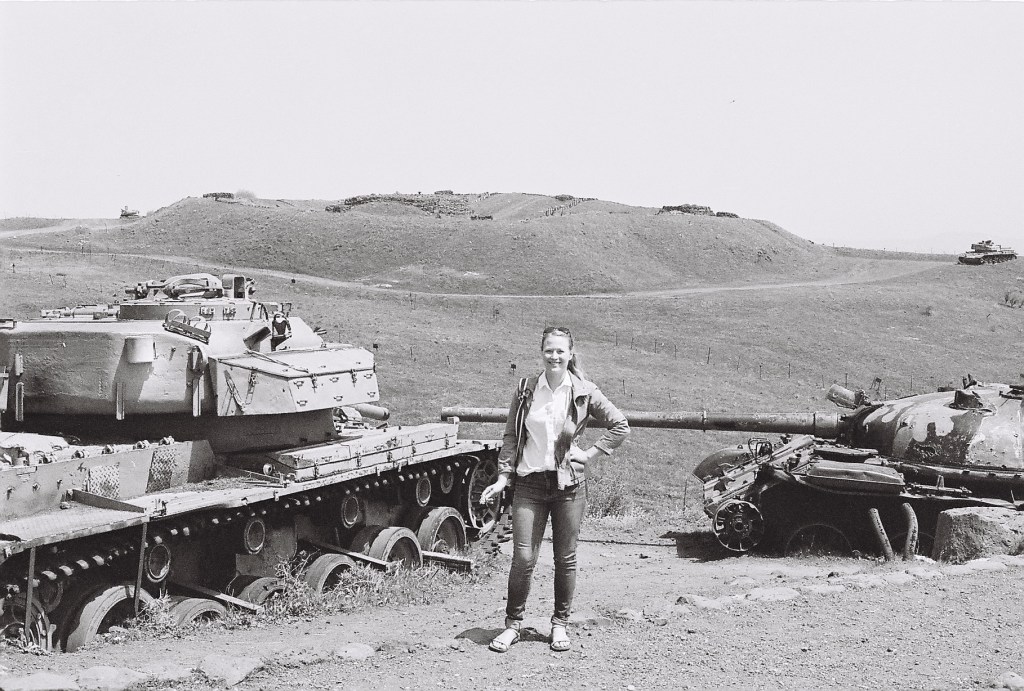
On day 4 of the battle, Commander Avigdor Kahalani rallied his outgunned and outnumbered tanks in a desperate and almost suicidal final attempt to stop the invasion. Amazingly, the Israeli forces prevailed and defeated the invasion force. Over 500 destroyed Syrian tanks and armored personnel carriers were left behind from the battle. Following their defeat at the Valley of Tears, the Syrian offensive was effectively stopped.

After the Yom Kippur War, the battleground became known as the Valley of Tears (in Hebrew, Emek Habaha). Today, a Jewish National Fund memorial site stands for fallen members of the armored corps from the 77th Brigade. The memorial is called Oz 77, from the Hebrew word for “strength.”

Part of the monument consists of a T62 Syrian tank, one of the tanks that spearheaded the Syrian attack. Look for the gaping hole in the front where it was hit in battle.

Continue reading

Minolta XG-1

“For my next camera, I’d like a Minolta,” I mentioned to my friend Zach as we both perused the camera section of the antique shop with its dusty Brownies and rusting Land camera. Scott and I had already restored several Land cameras and enjoy them very much. Scott’s favorite by far is his Polaroid SX-70, a truly beautiful instrument.

But I was craving an old glass lens, with sharp focus and blurred backgrounds, and contrasty black and white film. I’ve had my Holga since 2012, but it doesn’t give much by way of focus (that is to say, the focus is only a rough guess), and the viewfinder is only a rough estimate of what the lens will see.

Less than an hour later, Scott stumbled on this Minolta XG-1 for $15.

The near mint interior held a completed 12-exposure roll of Kodak film, color. His battery was dead, but not corroded. He was labeled to be sold as a “prop camera” by a seller who apparently thought he’d only be wanted for his looks. Unable to test the shutter without a battery, there was no telling if he’d shoot— but the real view seen through the viewfinder was lovely. Scott argued it was worth $15 to take the gamble, who cares if it’s a dud?

Once at home, Scott popped in two button batteries and the XG-1 clicked on like he’d just been used yesterday. With the exception of a loose power knob (that slides out of place a little too easily), he seemed to be working perfectly, the shutter snapping importantly with each test.

This camera is from circa 1982, a consumer level camera from Minolta. The lens is a fixed distance (no option to zoom in or out) 50mm lens. For my first roll of test film I used Ilford HP5 Plus, 400 ISO.

For an idea of what this camera could possibly be capable of, here’s a lomography page dedicated to images captured using a Minolta XG-1: https://www.lomography.com/cameras/3338520-minolta-xg-1/photos

And for an idea of how it works, you can find the original manual here: https://www.cameramanuals.org/minolta_pdf/minolta_xg-1.pdf

And here’s a few shots from my first roll of film (Iford HP5 Plus)…

Continue reading