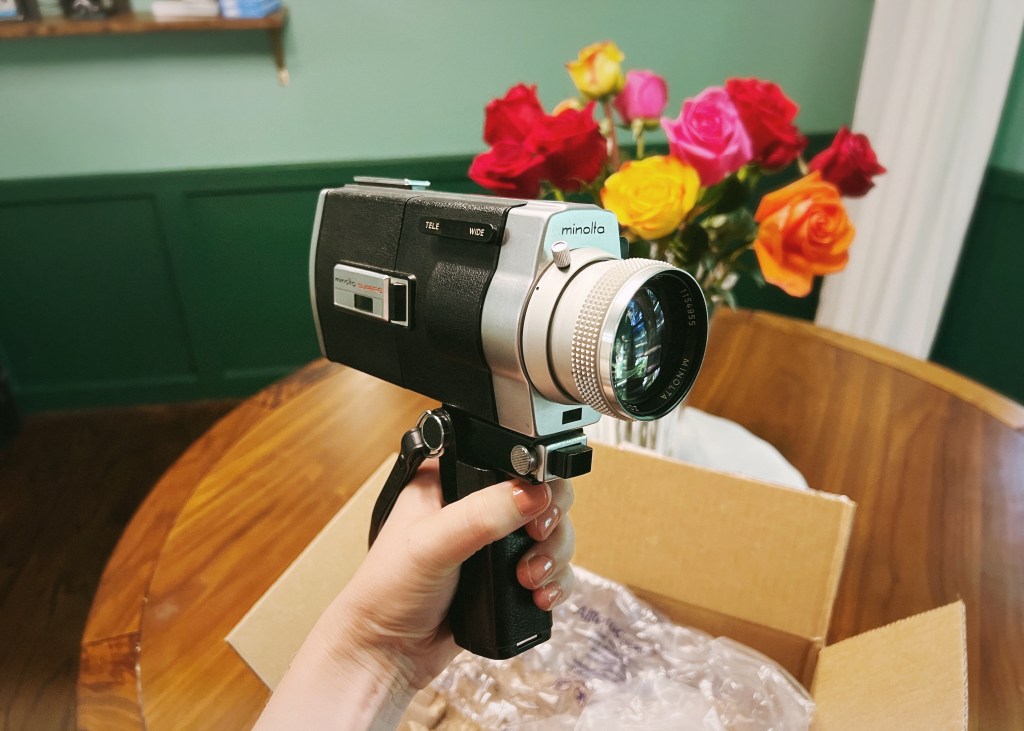
I first spotted my Minolta Autopak while perusing GoodwillFinds.com (now sadly defunct).
I was especially tempted by the promise of a Rokkor lens, the same type as my beloved Minolta XG-1.
Rokkor glass was made by Minolta in the 1970s, an impressive distinction when compared to other camera manufacturers who used pre-made glasses. The glass element was called “Rokkor”, in reference to Mt. Rokko, a mountain in Japan visible from the Minolta factory. The vintage Rokkor lenses have become a fan favorite among photographers for their sharp focus and soft bokeh. It’s hard to define the exact reason, but these lenses have a distinctive glass feel that I just adore.
She was on sale for $40. When I called my husband to get his weigh-in, his response was: “What’s $40? Get it.”
He did not yet know that the cartridges to actually make the camera run would run $39.95… but this is the same story with most of our vintage cameras. It’s not the cost of the camera that will get ya, it’s the film.
I hit the order button and crossed my fingers. Goodwill is not exactly a purveyor of tested and cleaned equipment. That’s the gamble. A cleaned, tested and refurbed model of this camera might run you $300-$600, while I’m gambling $40 plus shipping (I have no interest in casinos, but this type of gambling is potentially worth the pay-off!).

On arrival, I was delighted to find the camera in apparently good condition- no rust, no obvious signs of damage, a clear lens without fogging or deep scratches. The battery compartment was (thank the Lord) empty and had no signs of corrosion.
With four new double-As, she whirred to life with that satisfying clicking sound I was hoping for. I didn’t have any film cartridges just yet, but placed an order asap. (B&H, take my money!)
I decided to try out Kodak’s Vision3 500T film first. I planned to use the camera mostly outdoors in full light, so I added a Tiffen 85B color correcting filter to my cart. Tungsten films (denoted by the T) are designed for use indoors, while other films (marked D for daylight) are designed for outdoor use. A color correcting filter can help get the white balance right when you take a tungsten film outdoors.
Here’s my first attempt at a Super8 video, filmed in Key West, FL in Sept 2024…
Although the footage came out fairly dark, I’m still delighted with it. The vintage colors, the jumpiness of a handheld, the quick edits (meant to preserve time on a roll that only lasts 3 minutes), plus that iconic film shape with the black sprocket-hole in the corner— all exactly the retro vibe I was hoping for!
My second attempt captured Christmas 2024.
This is not the camera of my childhood. I lived in the VHS home-camcorder era as a child. And honestly, there are advantages to the VHS recorders over Super 8.
Blank VHS tapes can be recorded and then watched immediately. There’s no need to dunk VHS film into a chemical bath— unlike Super 8 cartridges which must be sent off for development. There’s also the advantage of sound recording. VHS camcorders come equipped with a microphone. The Super 8 films are silent. There’s also a cost component, since VHS tapes can be taped over again and again (although you might eventually get some grain or color variations), while Super 8 cartridges are one and done.
But the Super 8, that satisfying whirring sound, the silly little imperfections… it all holds a certain charm, a retrospective nostalgia for ‘old family movies’ projected incandescently on a blank wall. What can I say? I am in my Super 8 phase.

Stats on my Camera:
- Produced 1970-1974
- Super 8 Cartridges
- Lens: Rokkor f: 1.8 \ F: 8.4-50 mm
- Focus: manual, microprism
- Power source: 4 double A batteries
Links I found useful while getting started:
- Myla Li Photos Guide to Shooting Super 8 Weddings
- B&H Photo always comes through with the film!
- Where I got my film developed
- Another option to get Super8 film developed
Here’s the user manual for this camera:
 Unbidden Grace